Best Pilates Reformer Alternatives: 6 Ways to Get Reformer-Inspired Resistance Without the Machine
The Pilates Reformer is a brilliant apparatus. It is also large, expensive, difficult to move and not exactly something you can slip into a closet—or a suitcase.
Fortunately, you do not need a giant sliding machine in your living room to experience many of the principles that make Reformer Pilates so effective.
A traditional Reformer uses a moving carriage, springs, ropes and a footbar to provide both resistance and assistance. The springs do not simply make an exercise harder. They guide the movement, support the body and provide continuous physical feedback.
No portable product can duplicate every feature of a traditional Reformer. But several alternatives can deliver resistance, support, balance challenges and full-body integration without requiring a dedicated Pilates studio.
Here are the best Pilates Reformer alternatives, beginning with our top choice.
1. TYE4X™: Best Overall Pilates Reformer Alternative
Wear the Reformer instead of finding room for it.
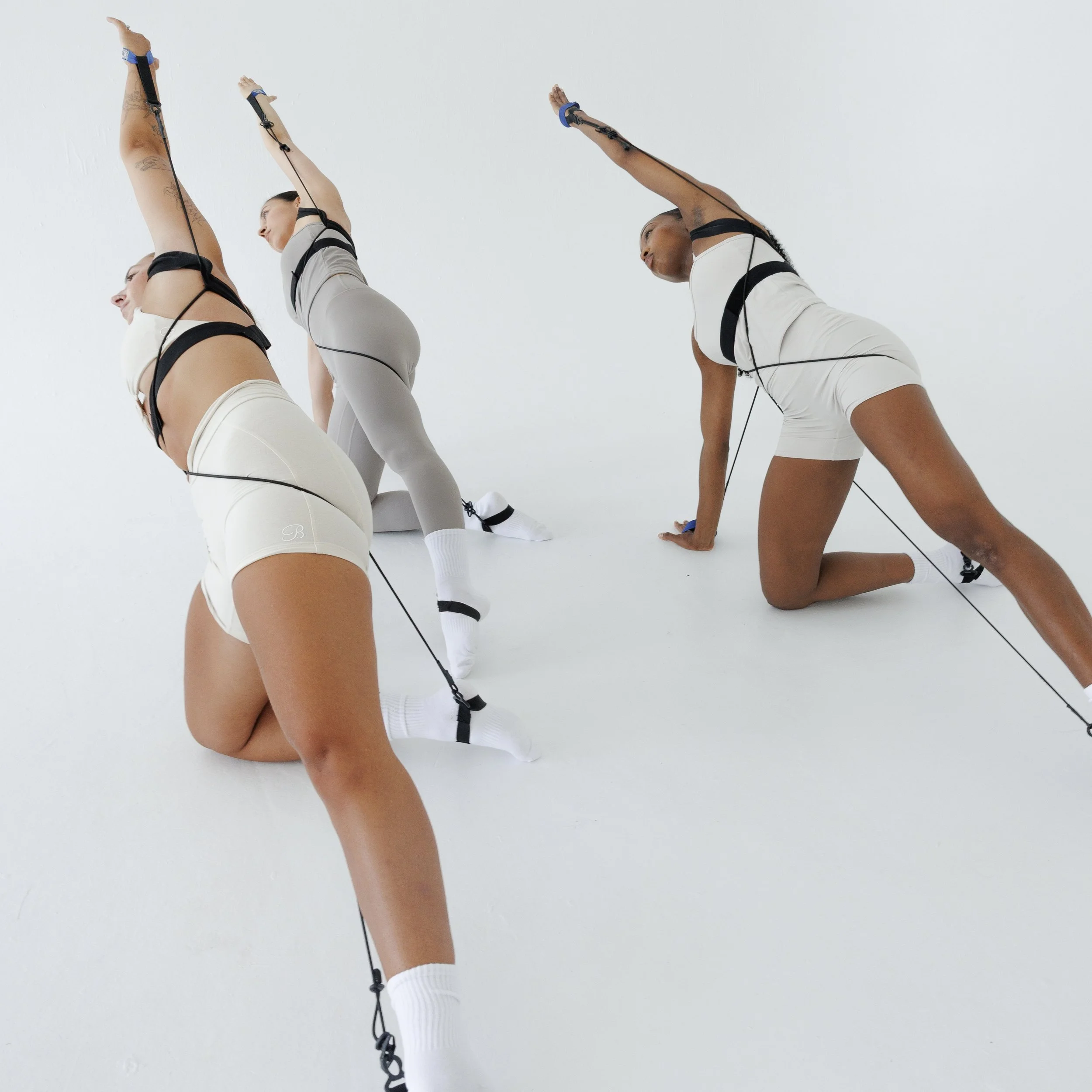
TYE4X™ is a patented, wearable resistance and assistance system designed to bring Reformer-like principles directly onto the body.
The fabric structure crosses the back and fastens around the torso, while bungee cords connect the arms and legs. Instead of pulling against resistance attached to a machine, the body works against—and receives support from—a connected resistance system.
Unlike ordinary resistance bands, TYE4X™ does not have to be tied to a door, wrapped around furniture or held awkwardly in the hands. Because the resistance is worn on the body, the arms, legs and torso can work together during standing, seated and mat-based movement.
TYE4X™ can be used for:
Pilates matwork
Standing Pilates
Barre exercises
Stretching and mobility
Posture training
Seated or desk exercises
Travel workouts
Reformer exercises adapted to the mat
PhysicalMind Institute describes TYE4X™ as a “Wearable Pilates Reformer” and has used it to deconstruct traditional Reformer exercises so they can be performed away from the machine.
Why TYE4X™ is our top choice
Most portable alternatives reproduce only one part of the Reformer.
Sliders imitate the carriage. Resistance bands imitate some of the pulling action. A Pilates bar approximates the footbar. TYE4X™ takes a more complete approach by connecting resistance through the upper and lower body at the same time.
Its bungee system can both resist and assist movement. This is important because Pilates is not simply strength training with elastic bands. Reformer springs provide support, opposition and feedback throughout an exercise.
TYE4X™ does not reproduce the sensation of lying on a moving carriage. What it does offer is something the Reformer cannot: the freedom to stand up, walk, rotate and move through space while remaining connected to resistance.
Best for: People who want a serious, portable, full-body Pilates system rather than a collection of disconnected exercise props.
2. Pilates Chair: Best Traditional Apparatus for Small Spaces
The Pilates Chair—often called the Wunda Chair—is a genuine piece of Pilates apparatus. Better yet, consider the MVe® Chair, invented by Joan Breibart, president of PhysicalMind Institute. Its spring-loaded pedal provides both resistance and assistance while taking up far less room than a Reformer.
A Chair is excellent for standing work, balance, leg strength, spinal control and upper-body support. Because its base remains stationary, it can also feel more demanding than the Reformer.
The disadvantage is that it is still a substantial piece of equipment. It is not easily portable, and many Chair exercises require careful instruction.
Best for: Experienced Pilates students who want authentic spring resistance and have room for one compact apparatus.
3. Pilates Springboard: Best Wall-Mounted Alternative
A Pilates Springboard attaches to a wall and uses springs, handles, straps and bars to create resistance.
It allows for a wide variety of seated, standing, kneeling and lying exercises. Because it uses actual springs, it can provide resistance and assistance that feel more like traditional Pilates apparatus than ordinary fitness bands.
However, a Springboard requires secure installation and a permanent section of wall. It also lacks the Reformer’s moving carriage.
Best for: Home studios with available wall space and users who want traditional spring-based Pilates work.
4. Sliders and Resistance Bands: Best Budget Alternative
Sliders placed under the hands or feet can imitate some of the movement of a Reformer carriage. Resistance bands can then be added to approximate the pulling action of springs and straps.
This combination works particularly well for exercises such as:
Sliding lunges
Knee stretches
Plank variations
Bridges
Leg presses
Arm pulls and rows
On a hard floor, small exercise sliders or even folded towels can create the gliding movement. On carpet, specialized sliders or smooth discs are usually needed.
The limitation is that sliders provide very little guidance or support. The user must create stability without the frame, footbar or shoulder rests of a Reformer. Bands may also pull unevenly, twist or lose tension as the body changes position.
Best for: Beginners who want an inexpensive way to experiment with Reformer-inspired exercises.
5. Pilates Bar: Best for Footbar-Inspired Exercises
A Pilates bar is a lightweight bar attached to resistance cords. It is often promoted as a portable substitute for the Reformer footbar and straps.
It can be useful for squats, presses, arm work, leg work and roll-down exercises. Many models can be disassembled and stored in a small bag.
The bar provides a clear place for the hands or feet, but it does not create the whole-body feedback of a Reformer. Most exercises remain linear, and the user must continually manage the loose cords and anchors.
Best for: People who enjoy simple resistance workouts and want a portable bar for presses, squats and basic Pilates exercises.
6. Mat Pilates With Props: Best Simple Starting Point
Joseph Pilates developed an entire matwork system that requires no machine at all. A mat, Pilates ring, small ball and light resistance band can create a surprisingly challenging workout.
Mat Pilates develops control because the body must work against gravity without the assistance of springs. Props can add resistance, improve awareness and help organize particular exercises.
However, piling more props onto a mat does not automatically turn the workout into Reformer Pilates. Without a connected resistance system, the props tend to isolate one body part at a time. Some of the best props include the Magic Circle, Parasetter and TYE4X.
Best for: Anyone learning the foundations of Pilates or wanting the simplest possible home practice.
Which Pilates Reformer Alternative Is Best?
The answer depends on what you are actually trying to replace.
Choose a Pilates Chair if you want a compact but traditional piece of apparatus.
Choose a Springboard if you have permanent wall space and want genuine springs.
Choose sliders and bands if your priority is spending as little as possible.
Choose a Pilates bar if you mainly want straightforward resistance exercises.
Choose mat Pilates and props if you want to concentrate on the fundamentals.
But if you want resistance, assistance, posture feedback and coordinated full-body movement in something you can wear, store and take anywhere, TYE4X™ is the best overall Pilates Reformer alternative.
A Reformer asks you to place your body inside a machine.
TYE4X™ places the resistance directly on your body—and lets you move.