
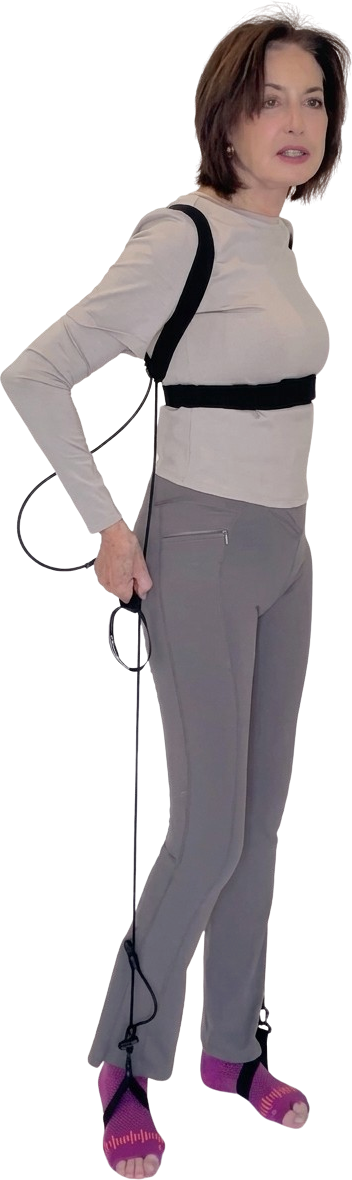
Fine. I’ll Trade on Being 85.
I’ve decided to do something with PhysicalMind that I said I would never do. But I’m flexible. I’m going to trade on being 85.
Apparently nobody wants to hear what I have to say unless I first prove that I’m old and don’t look sufficiently old. Because I don’t parrot the usual wellness chatter.
I don’t tell people to drink lemon water, meditate over their chia seeds, get ten thousand steps, express gratitude to the universe and be asleep by 9:17. So people aren’t particularly interested. Until they meet me. Then one of two things happens.
They say: “What’s your secret?”
Or, if they know about my 60-year connection to Pilates: “Oh. Well, that’s Pilates.”
Really? What exactly are they referring to?
I’m 85. I’m 5'6". I weigh about 123 pounds. My skin is relatively unlined, I have nice hair, and I apparently look considerably younger than my age.
How do I know? Whole Foods tells me.
Whole Foods is in my apartment building, so I buy my groceries there and always use self-checkout.
And I buy beer too. . Usually one bottle because Whole Foods has hundreds of beers and I like trying them. I recently had one with lime in it. Very adventurous.
My favorite is Peroni.
Now, if you buy alcohol at self-checkout in New York, the machine freezes and summons a Team Member, which is Whole Foods language for a person who works there.
Usually someone from Gen Z arrives to verify that I’m over 21.
I tell them: 4/14/1941.
Then comes the pause.
Then: “Wow!” or “That’s awesome!”
Or some equally original observation.Then they tell me I don’t look 85. Maybe 63.
Of course, 63 is probably still a dinosaur to them, but I’ll take it.
Last week I bought an entire six-pack of Peroni, so I got another opportunity to perform the birthday trick.
And yes, it’s superficial. But apparently superficial works. So fine. I’m going to use it.
Because the moment people decide you look good for 85, they desperately want THE SECRET.
This is where I usually disappoint them. They don’t actually want my secret. They want me to repeat their secret back to them.
They want:
“I eat clean.”
“I drink lots of water.”
“I meditate.”
“I strength train.”
“I get eight hours of sleep.”
“I’m grateful.”
“I look at the morning sun.”
Perfect. Another wellness celebrity has been born. We see this constantly in the media.
Some celebrity is asked about her morning routine and suddenly we get a minute-by-minute account of her existence. She wakes at 5:00 a.m. Naturally. She looks at the sun. She drinks hot water with lemon. She stretches. Then perhaps a cold plunge.
I recently heard about someone who does the cold plunge after the lemon water, so apparently sequencing is critical.
Then she exercises for an hour and a half. Then comes the smoothie containing fourteen virtuous ingredients nobody kept in a kitchen until 2012. Or an enormous “healthy” breakfast.
And on and on and on.
This is supposed to be useful information: It isn’t.
People ask what I eat. For years my answer was essentially: None of your business.
Not because I’m hiding anything.
Because why would my breakfast tell you what you should eat?
Unless you are my identical twin, why does it matter that I might have café au lait and a croissant with raspberry jam?
You can copy the croissant.
You cannot copy my body.
That is the fundamental silliness of wellness culture.
Everyone is searching for the formula.
The diet.
The workout.
The morning routine.
The supplement.
The hack.
The one thing that will somehow erase 30 or 40 years of doing one diet, then another diet, then no diet, then overeating, then restricting, then exercising like a lunatic, then doing nothing, then starting all over again on Monday.
People keep changing the formula and then wonder why the body isn’t behaving like a spreadsheet.
Meanwhile, the metabolic-health numbers in this country are terrible, and waist measurements make the problem rather difficult to hide.
The average American waistline is already around the level associated with substantially increased metabolic risk.
You don’t need a wellness retreat to see it.
You need a tape measure.
I have been arguing for years that waistline tells us something BMI often misses.
I’m not interested in whether somebody can manipulate a BMI category.
I’m interested in what is happening around the abdomen.
And yes, I quibble with some of the official waist cutoffs too.
Japan, for example, has long used waist circumference in metabolic-health screening, with a lower cutoff for men than the 40-inch number commonly used in the United States.
Which makes sense to me. Men do not get pregnant. A large male abdomen is not hiding a fetus.
But even getting Americans to stop obsessing about BMI and look at their waistline would be an enormous advance.
At the moment, we aren’t even there.
So yes, I am going to trade on my appearance. But appearance is only half of it.The more interesting thing is that at 85 I don’t feel mentally old.
I don’t have brain fog. My memory is good. I work. I write. I argue. I invent things. I change my mind.
Occasionally And most importantly: I think.
The brain is an enormously energy-demanding organ. Yet somehow when people exercise, they behave as if the objective is to switch the brain off.
Follow the instructor.
Copy the person in front.
Ten more. Nine. Eight. Feel the burn. Don’t think.
I believe exercise should do exactly the opposite.
You should have to pay attention. Where is your head? Where is your sternum? Where is your pelvis? Where is your weight? What is opposing what? Where are you compressing yourself when you could be creating space? How does one part of the body affect another?
That is much closer to the original idea of Contrology that interested me when I started Pilates in the 1960s. Control. Not choreography. Not exhaustion.
Not lying on a Reformer while somebody calls out spring settings.
And certainly not paying someone $150 an hour to count to twelve.
This is where my interest in biotensegrity comes in: thinking of the body as an interconnected structure in which movement, tension, support and opposition are distributed through the whole system rather than treating the body as a collection of isolated muscles to be punished one at a time.
That takes a brain.
A Reformer class may be fun.
But if you are going to spend an hour exercising, why not get as much from that hour as possible?
Train your body and your ability to sense, organize and direct it.
That idea is transferable.
I’m not telling you to eat my croissant.
I’m telling you to use a part of your anatomy that the fitness industry routinely forgets:
your brain.
And yes, this will involve our PhysicalMind products.
Of course it will.
I invented them because they reflect what I think movement should do. Someone may need one. Someone else may use two. Someone may use all of them. I use most of them. They are not a “morning routine.” They are tools.
And at 85, I take no daily medications and I don’t experience myself as having the usual symptoms people automatically associate with old age.
Does that prove everyone should live exactly as I do?
Absolutely not.
That would make me a wellness influencer.
God forbid.
But after spending most of my life refusing to tell people “Do what I do,” I’ve decided I can at least tell them what I do and why I do it.
And if I have to lure them in first with:
“I’m 85. Want to know my secret?”
Fine.
Apparently that’s marketing.
So everyone needs these:
80Bites App — $.99 and everyone who eats needs it.
Parasetter® — Every spine deserves to be on this dual roller system
MINIS —Read the reviews if you have foot pain
SmartSEAT — Make sitting good for your body
Professionals:
Fascia — Best program ever
Reformer Exercises Deconstructed (coming soon)
More Information
Body Conversations Podcast
Foundational Wellness Substack