
What is Bio-Tensegrity?
Contemporary approaches to the body and to movement apply the principles of bio-tensegrity — the balance between tension and compression, between form and function, between elastic tension and relaxation. The result is Global Integration.
Movement exists to expand the body, generate elastic tension, transfer loads and transmit forces. Good tension creates productive, functional kinetic energy, and it has a clear destination: Precision. Precise movement is economical movement — it consumes little energy and is achieved with minimal effort.
Our body works as a connected whole.
Vectors/Lines are pathways that help us understand how movement and forces travel through the body. When these pathways are properly activated, the whole body can work together more efficiently. The bio-tensegrity approach looks at how the body works as a whole. Better integration leads to better movement, better shape, and less effort. (fascial (good) tension). Dr. Elaine de Markondes MD DPT Pilates Expert
Two Opposing Approaches to the SQUAT
Squat: Compressive / Contracting Model This style looks at the shape of the body to achieve the client’s “fitness goals.”
Cueing:
“Keep your chest up and back straight.”
“Push your hips back like you’re sitting in a chair.”
“Drive your knees out.”
“Engage your core, squeeze your glutes at the top.”
Strategy:
Stability from compressing the spine and bracing the core.
Power from contracting quads, glutes, hamstrings in isolation.
Joints bear more direct compressive load (spine stacked, knees tracking).
Result:
Strong and controlled, but rigid.
Can feel heavy in joints (especially knees and low back).
The difference in “feel”
Compress/Contract squat → You push against the floor with muscles braced and spine locked.
Tensegrity squat → You yield into the floor, allow length and space, then spring back up like a coiled structure releasing.
Squat: Tensegrity / Bio-tensegrity Model This approach sees the total body and proceeds to how Joseph Pilates defined physical fitness as the attainment and maintenance of a uniformly developed body with a sound mind.
Cueing:
“Imagine your spine floating upward as you lower—length and lift at the same time.”
“Let your sit bones widen and drop, like the pelvis is opening a hammock.”
“Allow your knees to follow the path of your feet, softening rather than forcing.”
“At the bottom, feel expansion in all directions, then rise as if being buoyed up from below.
Strategy:
Stability from balanced tension in fascia and connective tissues.
Power from elastic recoil, distributed across the whole body.
Joints stay spacious—no “jamming” of knees, hips, or spine.
Result:
Feels springy, light, and integrated.
Less strain on knees/back, more energy return.
If you are a Pilates Teacher you are familiar with these cueing differences. But are you thinking three dimensionally: imagining your back, front, top ( top of the head) bottom (soles of the feet) and sides. All parts of the body you imagine as you begin the exercise choreography.
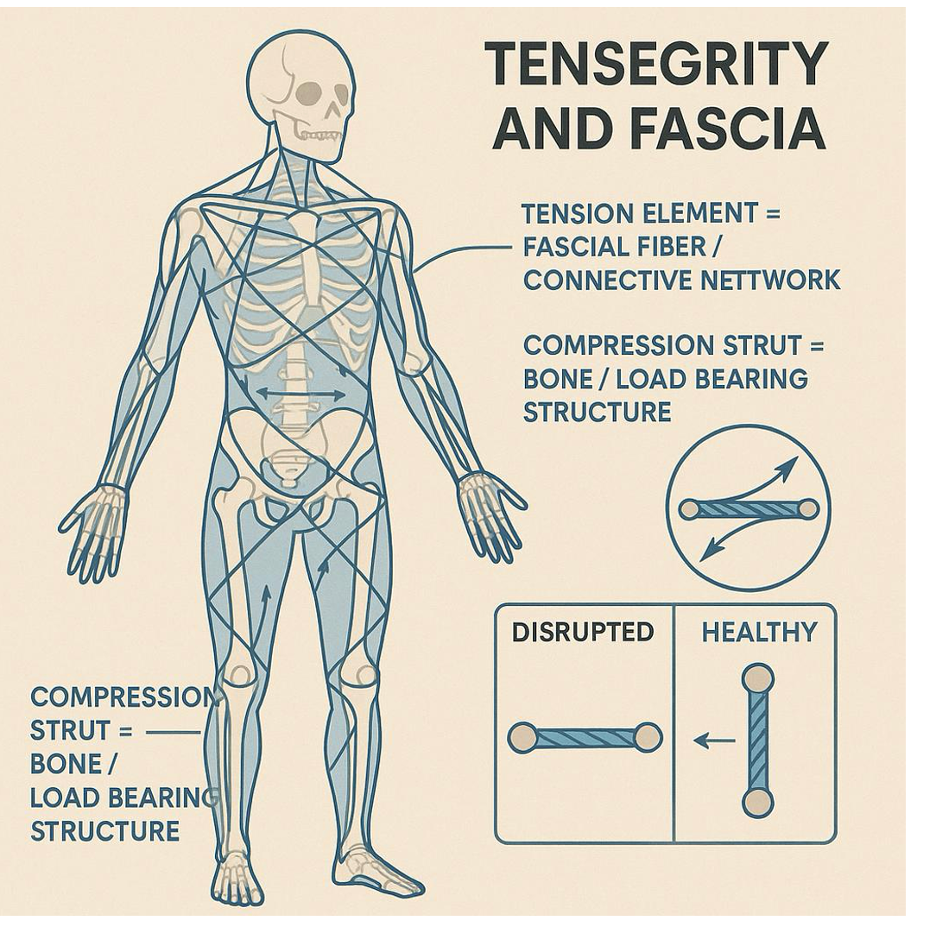
This image does not “explain” bio-tensegrity despite what many Wellness Experts might say: Bio-Tensegrity exists in your body and must be learned through your body. You can’t learn to play golf by reading a book and similarly you can’t learn bio-tensegrity that way either.