Analyzing Scottie Scheffler’s Golf Swing Through a Biotensegrity Lens
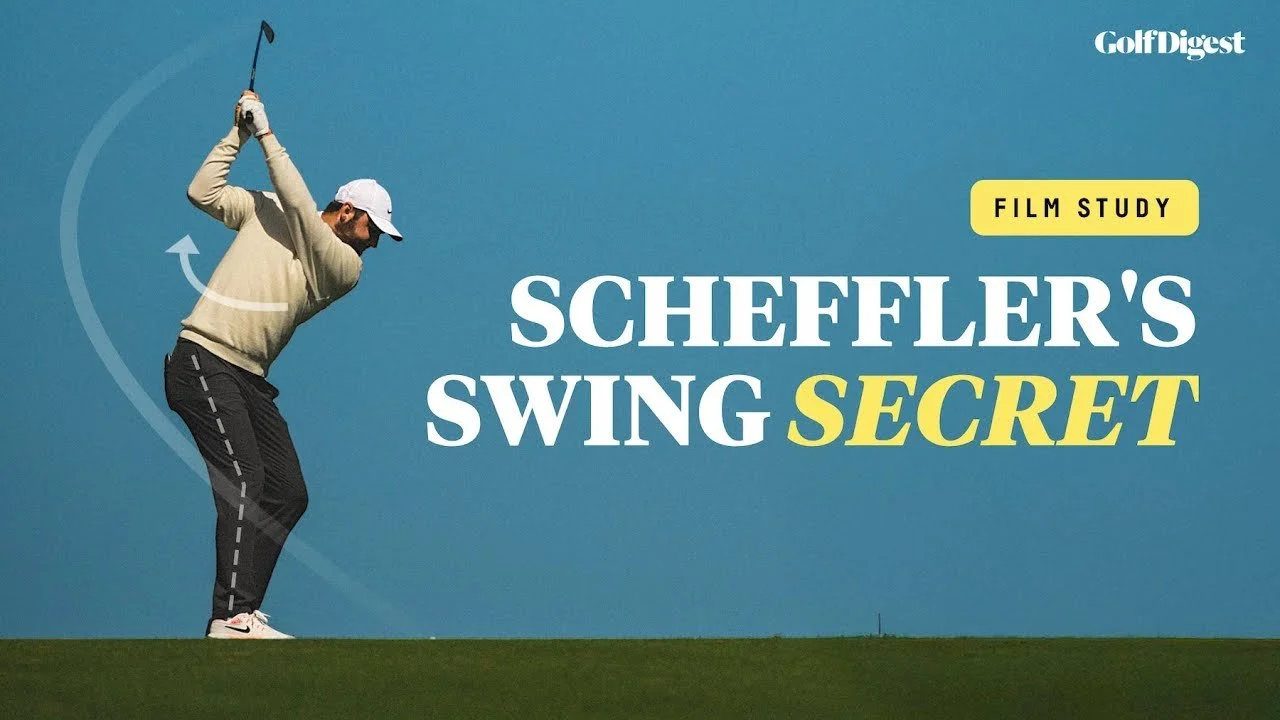
The video (https://www.youtube.com/watch?v=PrUAUUV3JrE) is very interesting, presenting detailed explanations on the step by step mechanics of a golf swing. It is clear that Scheffer’s approach to technique training is the tensegrity model, showing that the final gesture is an effect of progressive force transmission along specific body pathways.
It begins with the lower body stabilization, using a slight knee flexion to ground the lower limbs and a small inward rotation of the left hip, which promotes a controlled (but not restricted) pelvis rotation to the same side as the upper body torsion.
Using the Tye4X®, with both leg bungees wrapped around the front of the hips to stimulate spiral connections between the hips and the spinal axes is useful for promoting pelvic girdle grounding and stabilization. Mainly because this action provides the base of support of the entire movement.
The next step is upper body torsion to the right – involving shoulder girdle and spine – in opposition to the stabilized left leg. As the upper body rotates further to the right, the spiral elastic tension between the left foot and right shoulder, across the torso from right to left, and between the upper and lower body increases, promoting a rebound torsion effect in the opposite direction. Meanwhile, the shoulder levers and the weight of the gulf’s club enhances the momentum in the upper body, allowing for greater efficiency when performed correctly.
The Tye4X® arm bungees’ attached to each hand can further increase elastic tension around the torso and along the arms, enhancing both the movement’s elastic resistance and the rebound effect.
Finally, the golf swing concludes as the upper body rotates to the left side while the right leg at the back rotates inwardly and plantarflexes, marking the very end of the spiral movement involving the limbs and the spine. The rebound effect promoted by the body’s elastic tensions ensures wider ranges of motion with multidirectional body expansion in opposition.
Sheffer’s technique appears to result from a new approach to movement training based on biotensegrity principles, focusing on elastic tensions along and around the body to promote efficient force transmission along specific pathways, ensuring movement precision with minimal energy expenditure. The final gesture is a rebound of this effect.
Tye4X® provides elastic tensions connected to the body embodying tensegrity itself. It stimulates the balance between stretch and tone, as well as tension and compression, ensuring rebound responses as a result of a specific initial stimulus.
Dra. Elaine de Markondes
Médica | Fisioterapeuta
Presidente | Pilates Master Teacher